Oh! Community!
What's the collective noun for a group of community strategists? I'd go for an engagement.

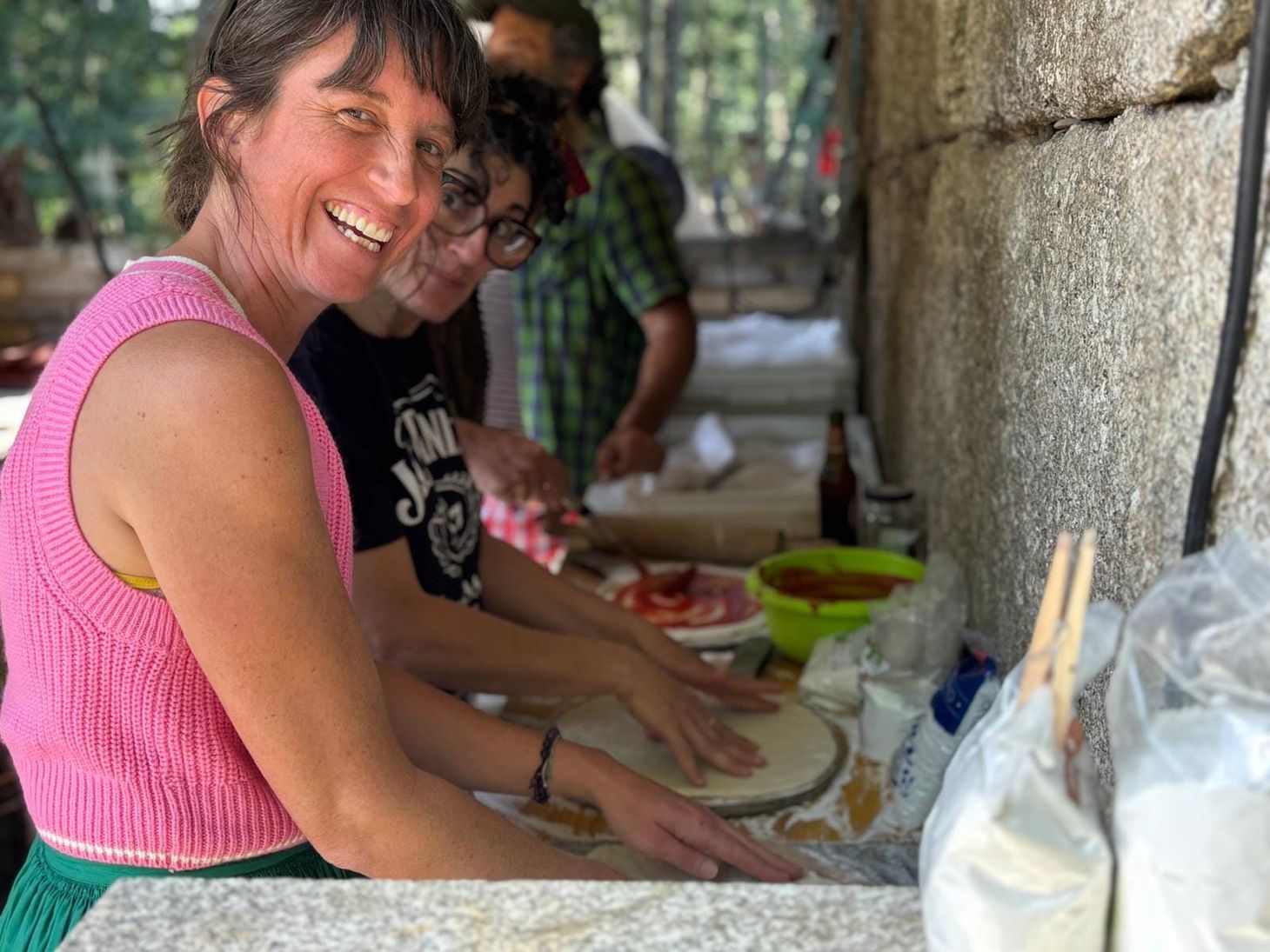
Table of Contents
It all happened so fast. Two weeks' previously, I'd woken from a sabbatical slumber with an epiphany. Since September, I'd been asking the kinds of questions one ponders on a sabbatical: As Abi Awomosu frames it, Who am I? What am I actually good at? What do I enjoy when nobody is paying me to do it?
Suddenly, the clouds parted, and I could see the thread. What I am is someone who loves being on a team, in a group, but more than that who wants to welcome people in, hold a container, give other people that sense that they belong.
It's why I spend my weekends organising festival team days, baking cakes for the swap shop, rallying with my neighbours for wood chopping days.
It's also what's helped me build brands, memberships and events. What turned a podcast into a room full of doctors saying "finally I feel seen"; what turned an app into an international circle of women sharing what's really happening in their relationships; what ultimately sold courses and coaching and memberships. Great marketing was never about clever copy, it was about that sense of "I belong here".
So community was the through line - but was it actually a modality in its own right? I hopped on a call with the brilliant Cass Marketos - a connection from another community - who reassured me that Yes, this was A Thing, and pointed me at Patrick O'Keefe and the Community Signal podcast. There's something astonishing about discovering that something you thought was just the "fun bit" of your work is its own field - with a smart, engaged community (ha!) of people sharing and connecting and figuring out how to do it even better.
I was explaining this to Ineke, someone I reconnected with seemingly at random many years after we first made contact as fellow immigrants to portugal - and a few hours later she texted me this:
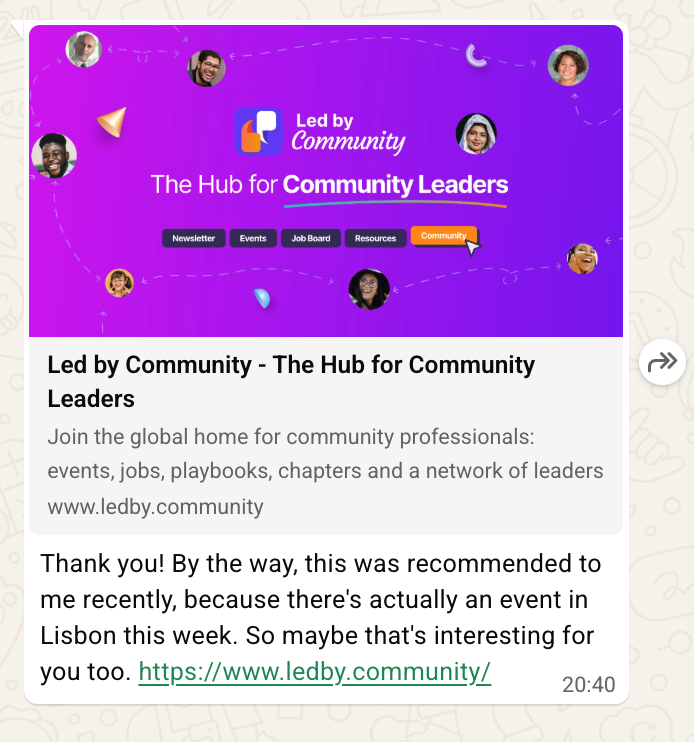
Four days later, I'm in a room in Lisbon, talking to people who lead, manage and facilitate communities for a living - and feeling like I've finally come home.
Here are a few things I learned.
Community takes many forms
I've managed Facebook groups, Whatsapp groups and Mighty Networks. But at Impact Hub I talked to people who ran gaming forums with tens of thousands of users; people building communities (not just audiences) via social media accounts; peopl creating unforgettable small scale in person experiences; leading professional networks of hundreds of people. From Reddit and Hubspot to a handmade festival of volunteers; the scale and the tech vary hugely, and yet the questions we asked each other were the same.
A community is more than just a crowd of people. It's defined by boundaries, and the actions and moments that mark them. How do you enter? How do you exit? How do you engage? It might be the sequence of onboarding emails after someone buys a product; the scavenger hunt that invites people to explore a venue; the automation that cancels someone's membership if they don't engage; the personal energy tracker that tells you not to introduce someone to more people in your network.
This got me thinking about thresholds and rituals - how we know we've crossed something. As social animals, I think we're wired to sense these moments of belonging. We've all felt that little stomach lurch when we realise - I'm not "in" that group any more - or the thrill of arriving somewhere and feeling instantly at home. There are settings where I straight away felt part of a community (this conference was one!) and others where I still don't feel I have a right to be there.
People don't behave the way you think they will
Some of the most active users of a product might never show up in the forums - but if you reach out to them, they can become your brand's biggest ambassadors. Andrea Tulcidis broke down what AI can tell us about communities, but also what it can't do.
It got me thinking about Unifant festival. As well as the three-day event, we host multiple "team days" throughout the year. The assumption is that people will show up to help out on a team day, and then want to come and volunteer at the festival.
That's not what happens! We had people who showed up for every team day, giving hours and hours of time, but didn't actually want to come to the festival. We had people who never showed up to a single team day but worked tirelessly at the event. And then people who'd never heard of the community but wanted to join the party - and later discovered the network behind it.
Andrea's take: Know the moments you DON'T want to automate and protect them. In fact, before automating, "Ask if it removes friction, or removes the human".
This question has sparked so many ideas for me, both about our in-person festival and about our online community accompanying the Velaia app. On a wider level, I'm starting to ask myself this question before I change to an automation in my day to day life to. What don't I want to automate? What am I committed to to protecting, to staying human?
Engagement is the holy grail
What's the collective noun for a group of community strategists? I'd go for an engagement. It's the metric we measure ourselves by, because it's how we show what we're doing is working. Who logs in, who asks questions, who responds, who comes back.
But it's not the whole story. Something else we talked about was belonging. Kirsten Wagenaar had so many smart things to say on this topic, and on the evolution of a community that is simply "together" vs one which is truly connected. Exposure Therapy, the creative strategy community I'm part of, exemplifies this: it's driven by the connections between members. (It's also how I met Cass.)
This is something data doesn't always show us. Who feels a sense of loyalty to your brand our project? Whose day is a little lighter knowing your forum is there? Who is going to need that support in future, even though right now things are flowing smoothly?
Community shapes culture
I've reflected a lot on what I learned in Lisbon, since returning to the hills. And I have many more articles to write about what I learned, and who inspired me. It was at a Deep Cultural Narratives Learning Studio a week later that something else clicked into place for me: Community is not only how we show up and belong together, it's how we create habits that shape bigger cultural narratives.
Whether your social media audience, your product users or your team - the connections between people and the norms we create together in these small, brilliant pockets shape how we interact with each other and the world. I think about a brick and mortar shop - another project that I'm working on which, it turns out, is deeply driven by community. Where I live, we say "good afternoon" to everyone when we enter a space. Even fleetingly, we become part of a network of people sharing a space. And that reflects an underlying narrative, about the respect we give each other, and the way we can open up to one another in shared public spaces; the way we recognise our collective identity over and above our right to be anonymous or private or unseen.
In the past I've held roles called marketing or mediation or operations or customer service or retention. What's shifted for me now, is seeing how all of them work by cultivating connections, and the immense amount of power they have to shape our underlying approaches to moving in the world.
And I'm excited to explore.


Madeleine Forbes Newsletter
Join the newsletter to receive the latest updates in your inbox.